
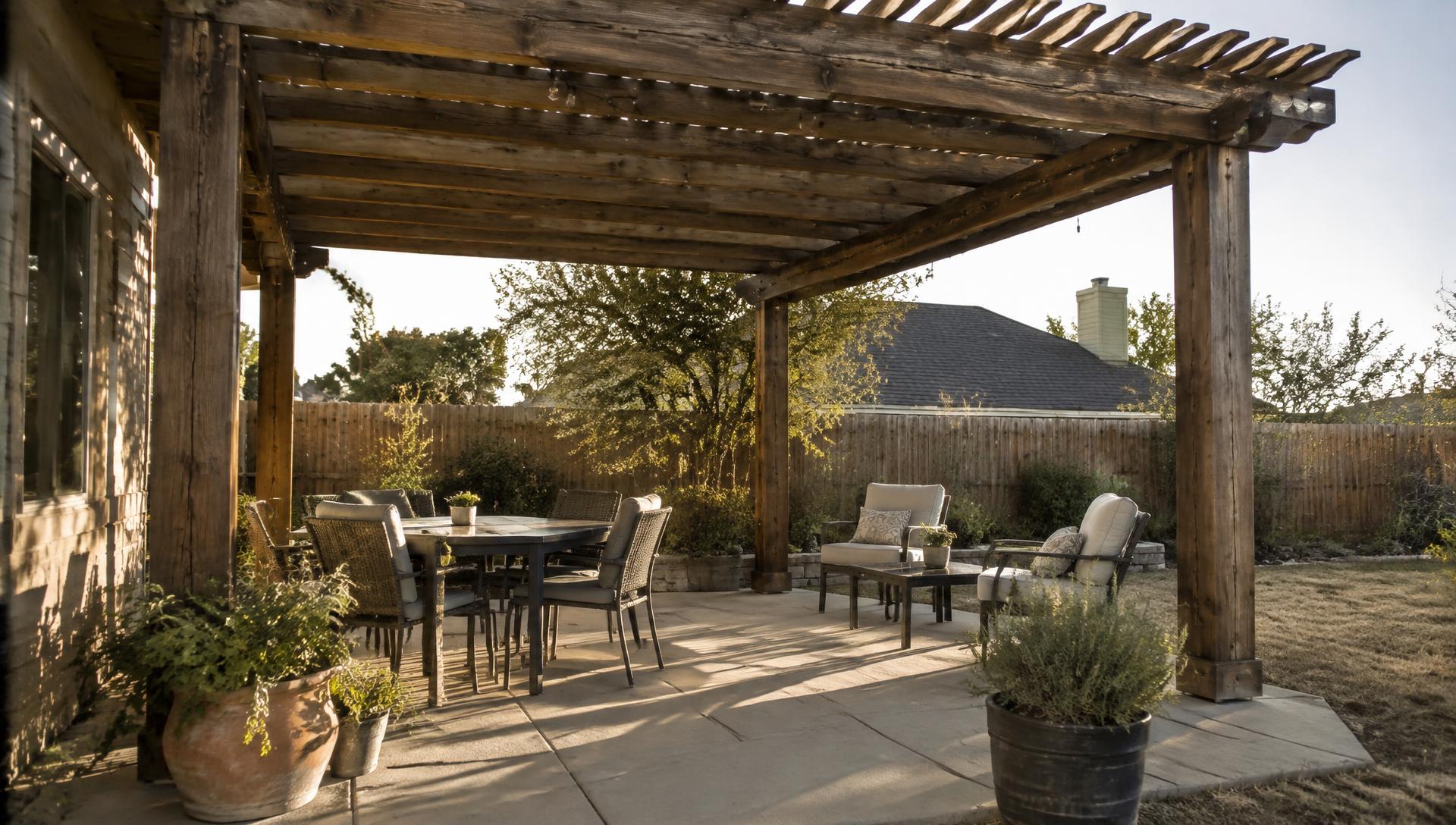
Choosing between a wood and metal pergola involves more than matching your house. The material affects the structure’s appearance, maintenance routine, and design possibilities. But material alone does not determine how much shade you get or how well the finished pergola handles exposure.
When we help Abilene homeowners plan a pergola, we start with how they want to use it and what upkeep they are comfortable taking on. Here is how we recommend comparing wood and metal before settling on a design.
Start with what you want from your pergola
A pergola creates an outdoor gathering area with an overhead framework. A traditional open-top pergola provides filtered shade rather than a continuous roof. Whether that framework is wood or metal, sunlight and rain can pass between the overhead members.
Before choosing a material, identify your priorities:
- Do you prefer a natural wood appearance or a more streamlined finish?
- Are you willing to inspect and renew a wood finish periodically?
- Is filtered shade enough, or do you want more overhead coverage?
- Do you want the pergola to coordinate with an existing deck or patio?
Separate your material decision from your shade decision. Closely spaced wood members can provide more shade than widely spaced metal members, and the reverse is also true. The complete design matters more than the material label.
Why homeowners choose wood pergolas
Wood gives a pergola a warm, substantial appearance. Visible grain, exposed beams, and decorative end cuts can suit traditional homes, while simpler detailing can work with more contemporary architecture.
Wood also offers flexibility in finish. Depending on the wood species and product requirements, a pergola may be stained or painted to coordinate with the home. We recommend looking at finish samples outdoors because direct sunlight can make colors look different from an indoor display.
The important distinction is that “wood” is not one uniform choice. Species, grade, treatment, and moisture condition affect suitability and detailing. A wood name alone does not tell you whether a proposed beam size or connection is appropriate.
Wood can also develop small surface cracks, called checking, as its moisture content changes. Some checking is normal, but significant splitting, movement, or deterioration deserves evaluation. During planning, we discuss the appearance you want alongside the care the specified wood will need.
What to understand about metal pergolas
Metal pergolas often appeal to homeowners who prefer clean lines and a consistent finish. However, aluminum and steel should not be treated as interchangeable.
Aluminum is relatively lightweight and does not rust like steel, but it can still experience corrosion under certain conditions. Steel can provide strength and stiffness, but exposed steel needs appropriate corrosion protection. Either option depends on suitable member sizes, connections, anchoring, and finish quality.
Factory-finished components can reduce some routine finishing work, but low maintenance does not mean no maintenance. Scratches, damaged coatings, loose components, and areas that collect water still need attention.
If you are comparing metal pergola proposals, ask what metal is specified, how it is protected, and what care the finish requires. We also recommend asking how visible damage would be repaired. Some finishes allow straightforward touch-ups; others require a more specific repair process to preserve their appearance.
Compare the maintenance you will actually do
The best material choice is partly a lifestyle decision. A finish that requires periodic attention may be perfectly reasonable for one homeowner and frustrating for another.
For a wood pergola, maintenance generally involves:
- Cleaning with methods appropriate for the wood and finish.
- Checking for peeling coatings, exposed wood, and persistent moisture.
- Inspecting connections and areas where wood meets hardware.
- Renewing the finish according to its condition and product instructions.
For a metal pergola, maintenance generally involves:
- Washing away dust and residue using approved cleaners.
- Inspecting coatings for chips, scratches, or deterioration.
- Checking fasteners and connections for movement or corrosion.
- Keeping drainage paths clear where the design includes them.
We avoid promising a universal refinishing schedule. Exposure, finish type, construction details, and cleaning practices all affect when attention is needed. Follow the instructions for the actual materials installed rather than a generic calendar.
Do not confuse material with cooling performance
In an Abilene summer, the question is often, “Which pergola will feel cooler?” There is no reliable answer based only on wood versus metal.
Metal surfaces exposed to direct sun can become hot, and wood surfaces can become hot too. For people sitting beneath the structure, the amount and timing of shade are usually more useful planning considerations than the temperature of an overhead beam.
We look at overhead member spacing, sun direction, finish color, and any proposed shade components together. A darker finish may absorb more solar energy, but color alone does not predict comfort beneath the pergola.
If you want an adjustable shade feature, bring it up early. Fabric panels, louvers, or other components affect connections and structural loads. They should not be treated as automatically compatible accessories that can be added later.
Look closely at connections and anchoring
A substantial-looking pergola is not necessarily a properly supported pergola. Wood and metal structures both depend on a continuous connection between the overhead framework, posts, anchors, and supporting foundation.
An existing concrete patio is not automatically suitable for post anchoring. Its thickness, condition, reinforcement, and underlying support may need evaluation. Likewise, attaching a pergola to a house requires more than choosing convenient fastening points.
We consider the complete structure rather than assuming heavier material is better. When required, engineered details help establish appropriate members, connections, and foundations. Permit requirements and HOA approval should also be checked before construction; neither should be assumed unnecessary because the structure has an open top.
Compare complete quotes, not material names
Neither wood nor metal is always the less expensive choice. Pricing comes from a quote based on the proposed project.
Cost factors include the specified material, finish, structural spans, foundations, connection details, site access, and any shade features. Decorative detailing and custom fabrication can also affect the scope.
When comparing proposals, make sure they describe comparable work. A basic open wood framework and a metal pergola with adjustable overhead components are different projects, not a simple material comparison.
We design and build pergolas directly, so we can discuss the structure and installation together. Explore our pergola design and construction services as you consider your options.
Frequently asked questions
Is a metal pergola maintenance-free? No. Metal pergolas still need cleaning and inspections. Coating damage, corrosion, and loose connections should be addressed using methods appropriate for the specified material and finish.
Does a wood pergola provide more shade than a metal pergola? Not automatically. Shade depends on overhead spacing, member dimensions, orientation, and any additional shade components. We compare complete designs rather than assuming one material blocks more sunlight.
Can we change a pergola’s finish later? Sometimes, but the process depends on the existing finish and material. Wood may require stripping or preparation, while factory-finished metal may need specialized treatment. We recommend choosing your initial finish with future care in mind.
If you are comparing wood and metal pergolas for your Abilene home, request a quote from Abilene Outdoor Living.